
AI Agents: The Dawn of Autonomous Intelligence
Artificial Intelligence (AI) is rapidly evolving, moving beyond static models to dynamic, autonomous entities capable of complex decision-making and problem-solving. At the forefront of this evolution are AI Agents, sophisticated software programs designed to perceive their environment, process information, make decisions, and execute actions to achieve specific goals. Unlike traditional AI systems that often require constant human intervention or operate within rigid, predefined rules, AI agents exhibit a degree of autonomy, learning, and adaptability that is transforming industries and redefining the future of automation.
This comprehensive guide delves into the fascinating world of AI agents, exploring their fundamental concepts, architectural components, evolutionary journey, and diverse applications. We will demystify how these intelligent systems work, differentiate them from conventional AI workflows, and highlight their immense potential to revolutionize everything from customer service to scientific discovery. Whether you're a beginner curious about the next frontier of AI or a seasoned professional seeking to understand agentic architectures, this article will provide you with a solid foundation and practical insights into this transformative technology.
What Exactly Are AI Agents?
An AI agent is more than just a program; it's an intelligent entity that operates within an environment to achieve specific objectives. Think of it as a digital assistant with enhanced capabilities, able to not only understand commands but also to strategize, learn, and adapt. The core idea behind AI agents is to imbue AI systems with the ability to act autonomously, making choices and executing tasks without continuous human oversight.
Key Principles Defining AI Agents
Several fundamental principles distinguish AI agents from other forms of AI and traditional software [3]:
- Autonomy: AI agents operate independently, initiating actions and making decisions without constant human intervention. They identify and execute appropriate actions based on their understanding of the environment and goals.
- Goal-Oriented Behavior: Every action an AI agent takes is driven by a predefined objective. They evaluate the consequences of their actions against these goals, striving for optimal performance.
- Perception: Agents interact with their environment by collecting data through various inputs, such as sensors or digital feeds. This allows them to perceive changes and update their internal understanding of the world.
- Rationality: AI agents possess reasoning capabilities, combining environmental data with domain knowledge and past experiences to make informed decisions that lead to the best possible outcomes.
- Proactivity: Beyond merely reacting to inputs, agents can anticipate events and prepare accordingly. They can take initiative based on forecasts and models of future states.
- Continuous Learning: Agents improve over time by learning from past interactions, identifying patterns, and refining their decision-making processes. This adaptability allows them to evolve and become more effective.
- Adaptability: AI agents can adjust their strategies in response to new circumstances, handling uncertainty, novel situations, and incomplete information with flexibility.
- Collaboration: In multi-agent systems, AI agents can communicate, coordinate, and cooperate with other agents or humans to achieve shared goals, often involving negotiation and task allocation.
The Evolution of AI Agents: From Simple Reflexes to Autonomous Systems
The concept of intelligent agents has roots in early AI research, but recent advancements in Large Language Models (LLMs) have propelled them into a new era of capability. The evolution can be broadly categorized by increasing complexity and autonomy [4]:
1. Simple Reflex Agents
These are the most basic agents, operating on a simple if-then rule. They perceive the current state and react based on predefined conditions, without memory of past states or complex planning. Examples include a thermostat turning on/off based on temperature thresholds.
2. Model-Based Reflex Agents
These agents maintain an internal model of the world, allowing them to handle partially observable environments. They track how the environment changes over time and infer hidden states, enabling more informed reactions than simple reflex agents. A self-driving car using sensors to build a model of its surroundings is an example.
3. Goal-Based Agents
Goal-based agents plan sequences of actions to achieve specific goals. They consider future outcomes and use algorithms to find the most efficient path to their objectives. An inventory management system that plans restocking based on sales forecasts falls into this category.
4. Utility-Based Agents
These agents are more sophisticated, aiming to maximize their utility or desirability of outcomes. They evaluate different actions based on a utility function, balancing trade-offs to achieve the best possible result. For instance, a financial trading bot that optimizes for profit while minimizing risk.
5. Learning Agents
Learning agents adapt and improve their performance over time through experience. They use feedback loops to refine their behavior and decision-making processes, making them highly effective in evolving environments. Recommendation systems that learn user preferences are a prime example.
6. Hierarchical Agents
Hierarchical agents tackle complex, multi-step problems by breaking them down into smaller, manageable sub-tasks. Higher-level agents oversee and coordinate the activities of lower-level sub-agents. This structure is common in robotic process automation where a main agent orchestrates several specialized agents.
7. Multi-Agent Systems
These systems involve multiple agents collaborating or competing to achieve shared or individual goals. They exhibit emergent behaviors from their interactions and are crucial for distributed, real-world problems like supply chain optimization or complex simulations. [4]
The Architecture of AI Agents: Building Blocks of Autonomy
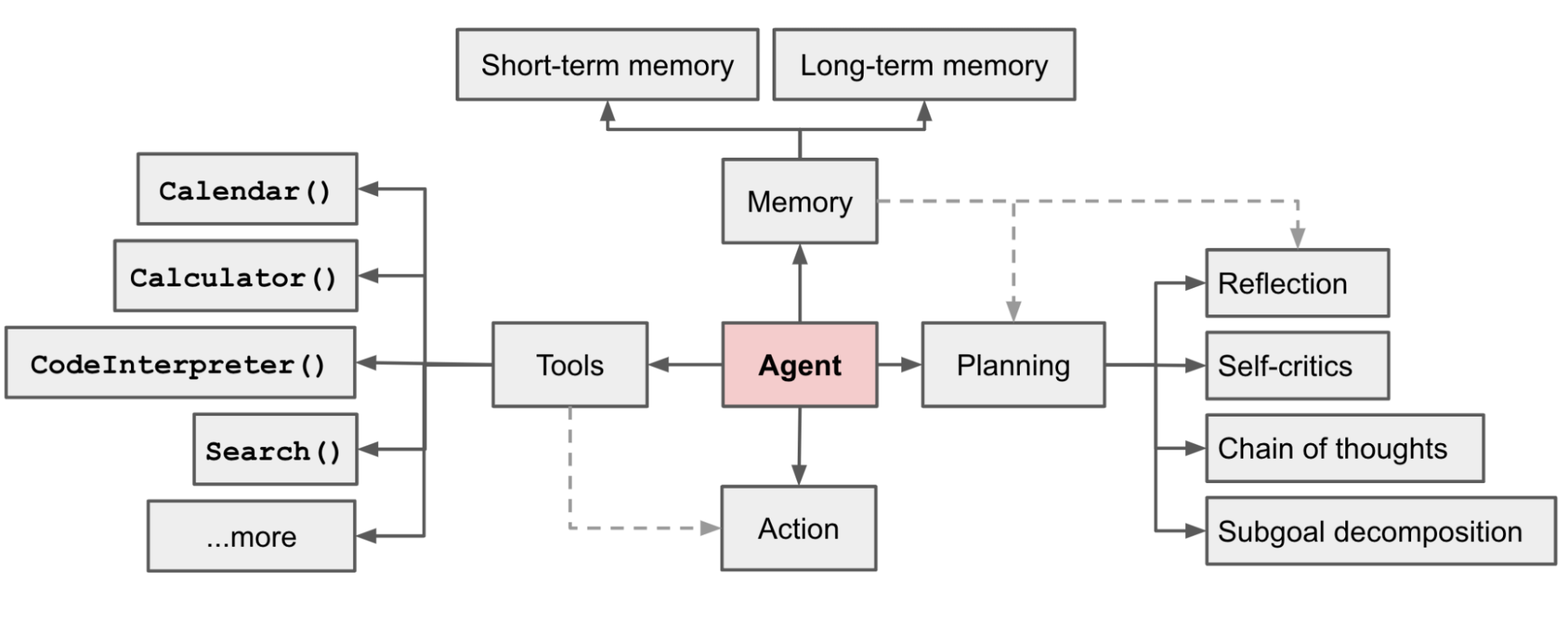
At the heart of every AI agent lies a sophisticated architecture that enables its autonomous capabilities. While specific implementations may vary, most AI agent architectures share several core components [3]:
1. Foundation Model (LLM)
Often, a Large Language Model (LLM) serves as the brain of the AI agent. It provides the agent with the ability to understand natural language instructions, generate human-like responses, and perform complex reasoning. The LLM processes prompts, translates them into actions, and queries other components like memory or tools. It also retains a form of short-term memory and can be integrated with external systems for continuous context awareness.
2. Planning Module
The planning module is responsible for breaking down high-level goals into smaller, actionable steps and sequencing them logically. This module can employ various strategies, from simple prompt-driven task decomposition to more formal algorithmic approaches like Hierarchical Task Networks (HTNs). Effective planning allows agents to operate over extended periods, managing dependencies and contingencies between tasks.
3. Memory Module
Memory is crucial for an agent to retain information across interactions and tasks. This includes:
- Short-term memory: For immediate context, such as conversation history or recent observations.
- Long-term memory: For accumulating knowledge, past actions, and domain-specific information. This is often implemented using vector databases or knowledge graphs for efficient storage and retrieval of semantically relevant content.
4. Tool Integration
AI agents extend their capabilities by integrating with external tools, APIs, or devices. This allows them to perform actions beyond natural language processing, such as retrieving real-time data, executing code, querying databases, or controlling hardware. The agent intelligently identifies when a tool is needed and delegates the task, interpreting the tool's output to continue its workflow.
5. Learning and Reflection
This component enables agents to improve over time. Reflection involves the agent evaluating its own performance, identifying errors, and refining its strategies. Learning can occur through various paradigms, including Reinforcement Learning (RL), where the agent receives feedback (rewards or penalties) from its environment and adjusts its behavior to maximize cumulative rewards. This continuous learning process allows agents to adapt to dynamic environments and become more effective with experience.
AI Agentic Workflows vs. Traditional Automation: A Paradigm Shift
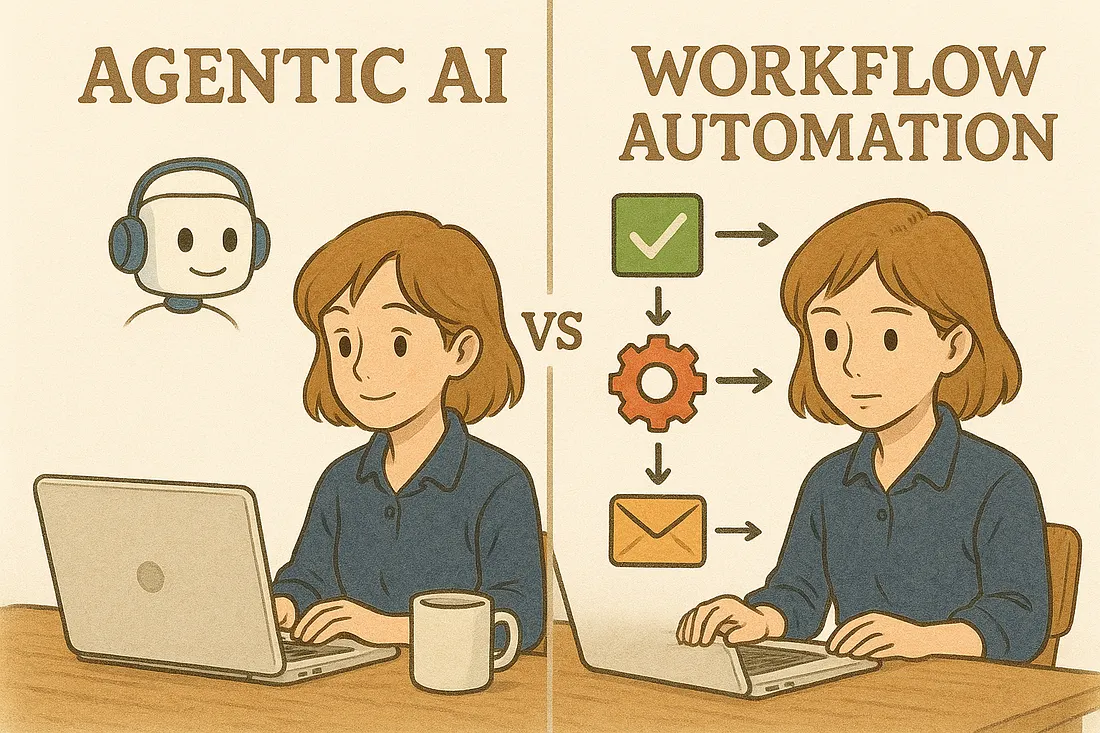
The rise of AI agents marks a significant shift from traditional workflow automation. While both aim to streamline processes, their underlying mechanisms and capabilities differ fundamentally [5]:
| Feature | Traditional Automation (RPA, Scripting) | AI Agentic Workflows |
|---|---|---|
| Decision-Making | Rule-based, predefined logic | Autonomous, adaptive, context-aware, goal-driven |
| Adaptability | Limited, struggles with exceptions | High, adapts to dynamic environments and novel situations |
| Learning | None, static | Continuous, improves with experience and feedback |
| Complexity Handling | Best for repetitive, well-defined tasks | Excels at complex, multi-step, ambiguous problems |
| Human Intervention | Often requires manual oversight | Minimal, self-correcting, and self-optimizing |
| Error Handling | Fails on unexpected inputs | Can reason, reflect, and recover from errors |
| Integration | API calls, structured data | Tool use, natural language interaction, diverse data sources |
| Scalability | Can become a bottleneck | Highly scalable, especially with multi-agent systems |
Traditional automation, often seen in Robotic Process Automation (RPA) or scripting, follows rigid, predefined rules. It's excellent for repetitive, high-volume tasks with clear, unchanging logic. However, it falters when faced with exceptions, dynamic environments, or tasks requiring nuanced decision-making. [5]
AI agentic workflows, on the other hand, are characterized by their flexibility and intelligence. They can interpret complex instructions, reason about their environment, learn from outcomes, and adapt their strategies. This makes them ideal for tasks that are ambiguous, require problem-solving, or involve interaction with unstructured data and dynamic systems. The agent's ability to self-correct and optimize its approach significantly reduces the need for constant human oversight, freeing up human resources for more strategic and creative endeavors. [5]
Practical Applications of AI Agents: Transforming Industries
AI agents are already beginning to revolutionize various sectors, offering innovative solutions to long-standing challenges:
1. Customer Service and Support
AI agents can handle complex customer queries, provide personalized support, and even proactively reach out to customers based on their behavior. They can access knowledge bases, integrate with CRM systems, and resolve issues much faster than traditional chatbots, leading to improved customer satisfaction.
2. Software Development
Autonomous coding agents can assist developers by generating code, debugging, testing, and even deploying applications. They can understand high-level requirements and translate them into functional code, accelerating the development lifecycle and improving code quality.
3. Data Analysis and Research
AI agents can automate data collection, analysis, and report generation. They can sift through vast amounts of information, identify patterns, and present insights, significantly speeding up research processes in fields like finance, healthcare, and scientific discovery.
4. Personal Assistants
Beyond current virtual assistants, advanced AI agents can manage complex schedules, make travel arrangements, handle communications, and even learn personal preferences to anticipate needs, offering a truly personalized and proactive assistance experience.
5. Healthcare
In healthcare, AI agents can assist with diagnostics by analyzing medical images and patient data, personalize treatment plans, manage patient records, and even support drug discovery by simulating molecular interactions.
6. Financial Services
AI agents can perform fraud detection, algorithmic trading, risk assessment, and personalized financial advice. Their ability to process real-time data and adapt to market changes makes them invaluable in this dynamic sector.
The Future of AI Agents: Challenges and Opportunities
The trajectory of AI agents points towards increasingly sophisticated and autonomous systems. However, several challenges need to be addressed:
- Safety and Ethics: Ensuring AI agents operate safely, ethically, and align with human values is paramount. This involves developing robust mechanisms for control, transparency, and accountability.
- Robustness and Reliability: Agents need to be highly reliable, especially in critical applications. This requires rigorous testing and development of fault-tolerant architectures.
- Explainability: Understanding how AI agents arrive at their decisions is crucial for trust and debugging. Developing explainable AI (XAI) techniques for agentic systems is an active area of research.
- Resource Management: Autonomous agents, especially multi-agent systems, can be computationally intensive. Efficient resource management and optimization are key for widespread adoption.
- Human-Agent Collaboration: Designing intuitive interfaces and interaction protocols for seamless collaboration between humans and AI agents will be vital for maximizing their potential.
Despite these challenges, the opportunities presented by AI agents are immense. They promise to unlock new levels of productivity, drive innovation across industries, and fundamentally change how we interact with technology. As research progresses and these systems become more refined, AI agents will undoubtedly play a central role in shaping our future.
Frequently Asked Questions (FAQs)
What is the main difference between AI agents and traditional AI?
The primary distinction lies in autonomy and adaptability. Traditional AI often follows predefined rules and requires human intervention for exceptions, while AI agents can autonomously perceive, plan, act, and learn from their environment, adapting to new situations without constant human oversight.
Can AI agents replace human jobs?
AI agents are designed to automate tasks, particularly repetitive or complex ones, which can augment human capabilities and increase productivity. While some tasks may be automated, the focus is often on creating new roles and opportunities for humans to work alongside AI, focusing on more strategic and creative endeavors.
What are some real-world examples of AI agents?
Examples include advanced customer service bots that resolve complex issues, autonomous coding assistants, AI-powered data analysis tools, personalized virtual assistants, and agents used in fraud detection or medical diagnostics.
How do AI agents learn?
AI agents learn through various mechanisms, including continuous feedback loops, reinforcement learning, and self-reflection. They analyze past interactions, identify patterns, and refine their decision-making processes to improve performance over time.
What are the ethical considerations for AI agents?
Ethical considerations include ensuring fairness, transparency, accountability, and preventing bias in decision-making. It's crucial to design agents that align with human values, respect privacy, and operate safely, especially in critical applications.